
Enhancing information security

Vulnerability Countermeasure Information Database JVN iPedia Registration Status [2025 4th Quarter (Oct. - Dec.)]
Release Date:Feb 18, 2026
IT Security Center
1. 2025 4th Quarter: Vulnerability Countermeasure Information Database JVN iPedia Registration Status
The vulnerability countermeasure information database JVN iPedia is endeavoring to become a comprehensive vulnerability database where vulnerability information is aggregated for easy access for IT users. JVN iPedia collects and/or translates the vulnerability information published by 1) domestic software developers, 2) JVN (footnote 1), a vulnerability information portal run by JPCERT/CC and IPA, and 3) NVD (footnote 2), a vulnerability database run by NIST (footnote 3). JVN iPedia has been making vulnerability information available to the public since April 25, 2007.
1-1. Vulnerabilities Registered in the 4th Quarter of 2025
JVN iPedia now stores 265,431 vulnerabilities
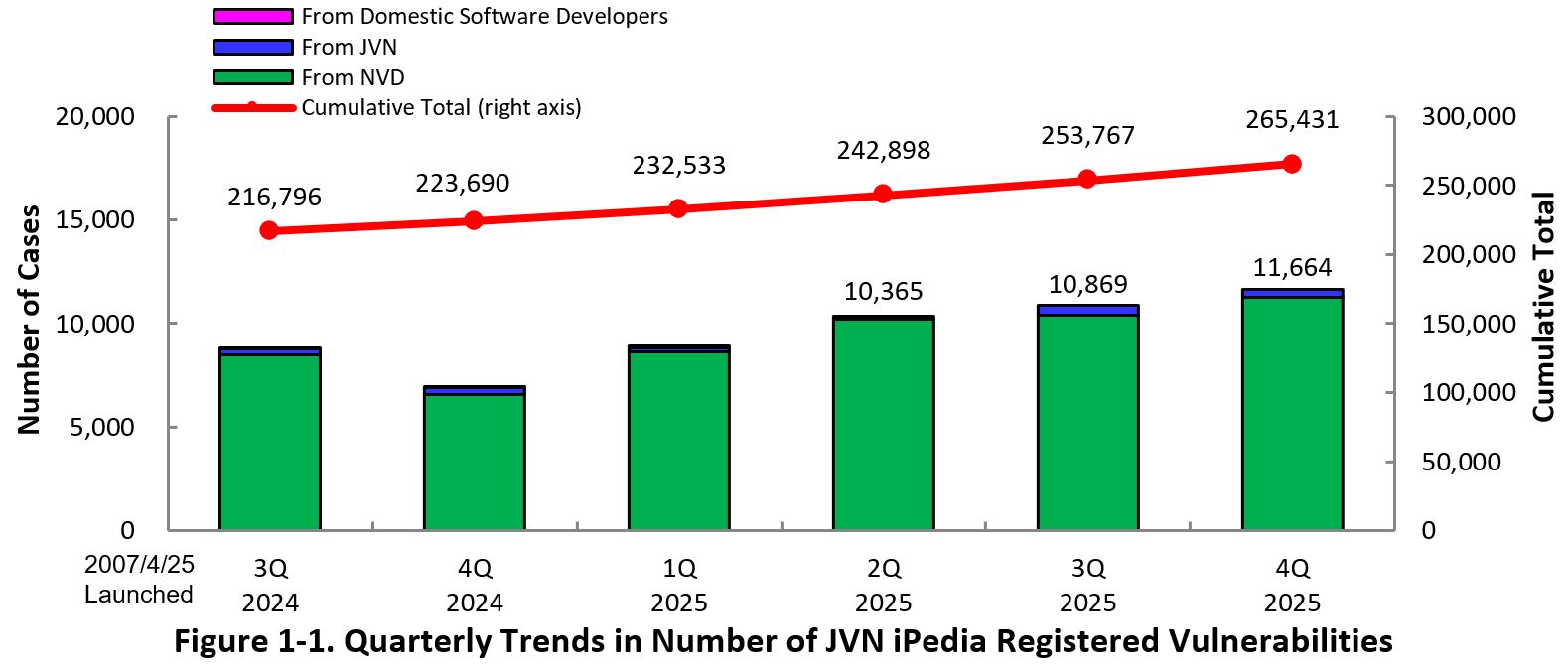
The summary of the vulnerability information registered to the Japanese version of JVN iPedia during the fourth quarter (October 1 to December 31) of 2025 is shown in the table below. As of the end of December 2025, the total number of vulnerabilities stored in JVN iPedia is 265,431 (Table 1-1, Figure 1-1).
As for the JVN iPedia English version, the total number of vulnerabilities stored is 3,121 as shown in the Table 1-2.
Table 1-1. Vulnerabilities Registered in JVN iPedia in the 4th Quarter of 2025 (Japanese Version)
| Information Source | Registered Cases | Cumulative Cases |
|---|---|---|
| Domestic Software Developers | 0 cases | 291 cases |
| JVN | 407 cases | 17,313 cases |
| NVD | 11,257 cases | 247,827 cases |
| Total | 11,664 cases | 265,431 cases |
Table 1-2. Vulnerabilities Registered in JVN iPedia in the 4th Quarter of 2025 (English Version)
| Information Source | Registered Cases | Cumulative Cases |
|---|---|---|
| Domestic Software Developers | 0 cases | 294 cases |
| JVN | 50 cases | 2,827 cases |
| Total | 50 cases | 3,121 cases |
2. Details on JVN iPedia Registered Data
2-1. Types of Vulnerabilities Reported
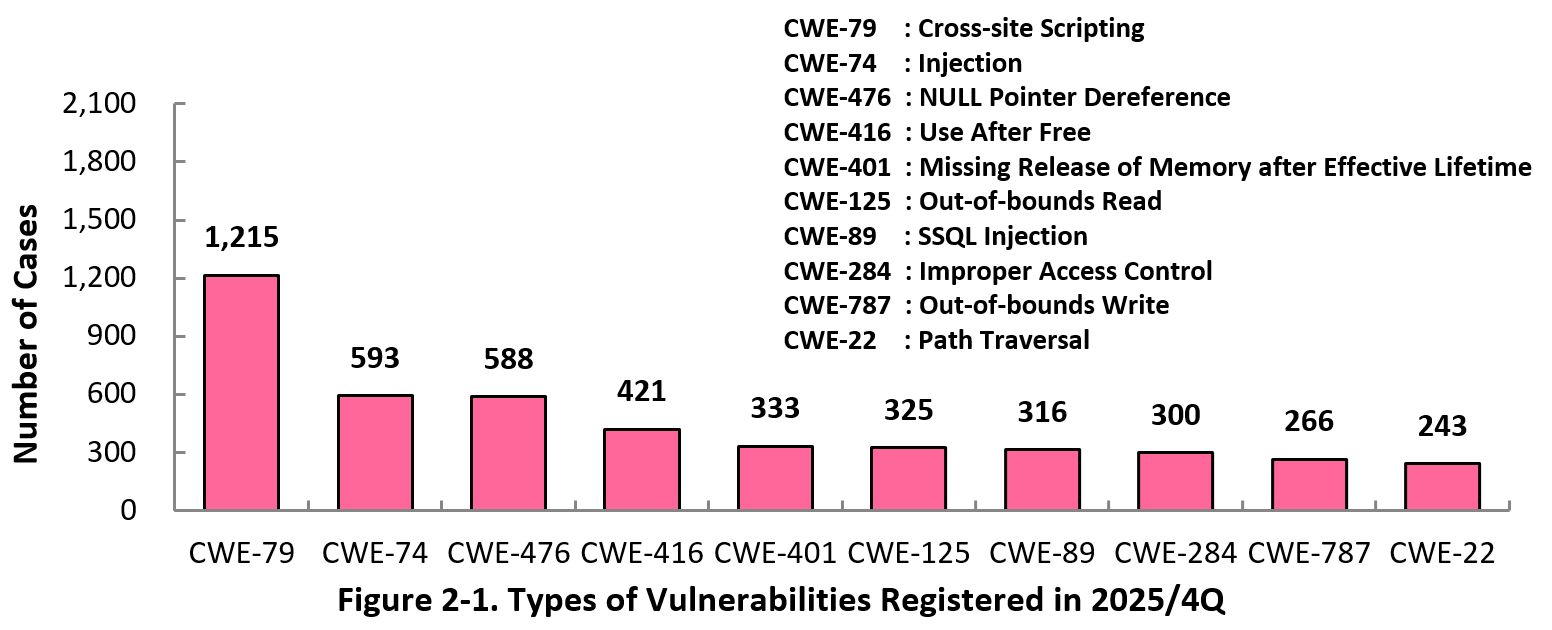
Figure 2-1 shows the number of vulnerabilities newly added to JVN iPedia during the fourth quarter (October 1 to December 31) of 2025, sorted by the CWE vulnerability types.
The type of the vulnerabilities reported most in the fourth quarter is CWE-79 (Cross-Site Scripting) with 1,215 cases, followed by CWE-74 (Injection) with 593, CWE-476 (NULL Pointer Dereference) with 588, CWE-416 (Use After Free) with 421, CWE-401(Missing Release of Memory after Effective Lifetime) with 333. CWE-79 (Cross-site Scripting), the most reported vulnerability type in this quarter, could allow attackers to display false webpages and/or steal information.
Software developers need to make sure to mitigate vulnerability from the planning and design phase of software development. IPA provides tools and guidelines, such as “Vulnerability Countermeasure Guide for Software Developers” (footnote 4), “How to Secure Your Web-site” (footnote 5), and “AppGoat” (footnote 6), a hands-on venerability learning tool, for website developers and operators to build secure websites.
2-2. Severity of Vulnerabilities Reported
Figure 2-2 shows the yearly change in the CVSSv2 rating scale based severity of vulnerabilities registered to JVN iPedia.
As for the vulnerabilities added to JVN iPedia in 2025, 39.3 percent are “Level 3” (7.0 - 10.0), 52.5 percent are “Level 2” (4.0 – 6.9) and 8.2 percent are “Level 1” (0.0 – 3.9). This means 91.8 percent of all vulnerabilities registered are Level 2 or higher, which are potentially critical enough to cause damage like information exposure or data falsification.
The reason for the significant decrease in the number of CVSSv2 registrations in JVN iPedia in 2024 is that CVSSv2 is not actively evaluated by NVD, the information collection source for JVN iPedia (footnote 7).
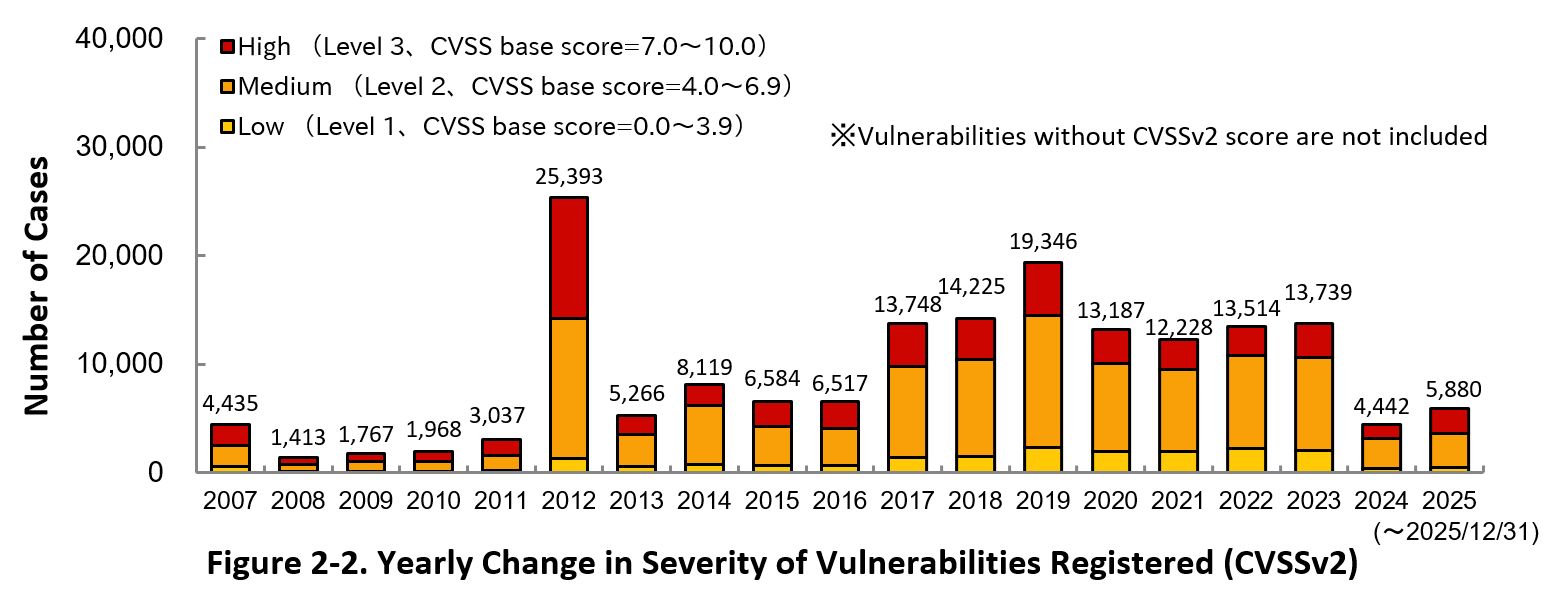
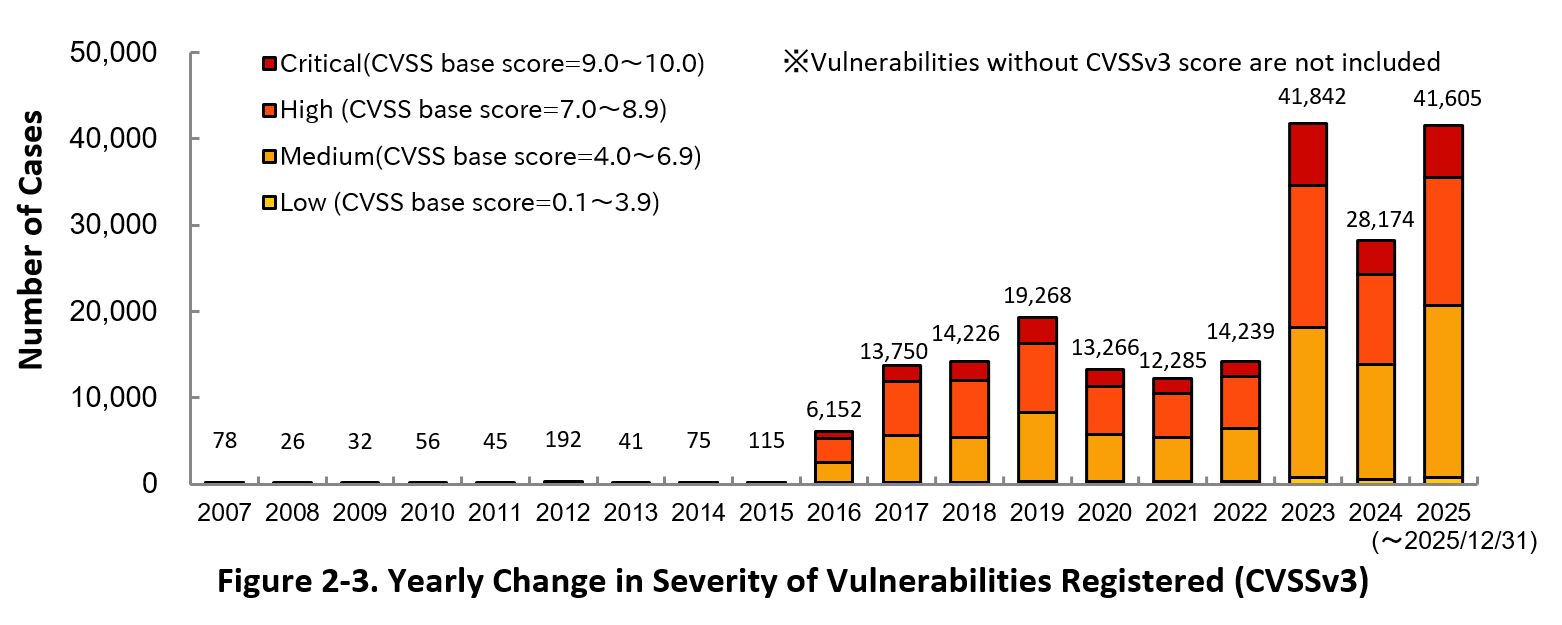
Figure 2-3 shows the yearly change in the CVSSv3 rating scale based severity of vulnerabilities registered to JVN iPedia.
As for the vulnerabilities added to JVN iPedia in 2025, 14.7 percent are “Critical” (9.0 – 10.0), 35.5 percent are “High” (7.0 – 8.9), 47.8 percent are “Medium” (4.0 – 6.9) and 2.0 percent are “Low” (0.1 – 3.9).
To avoid the threats posed by the known vulnerabilities, both product developers and IT users should pay close attention to vulnerability disclosures and update the software they use to a fixed version or apply a security patch as soon as it becomes available. They can also check JVN iPedia for new vulnerabilities that are in RSS and XML formats (footnote 8).
2-3. Types of Software Reported with Vulnerability
Figure 2-4 shows the yearly change in the type of software reported with vulnerability. Application vulnerabilities have been published most, accounting for 67.0 percent (27,963 out of 41,742) of the 2025 total.
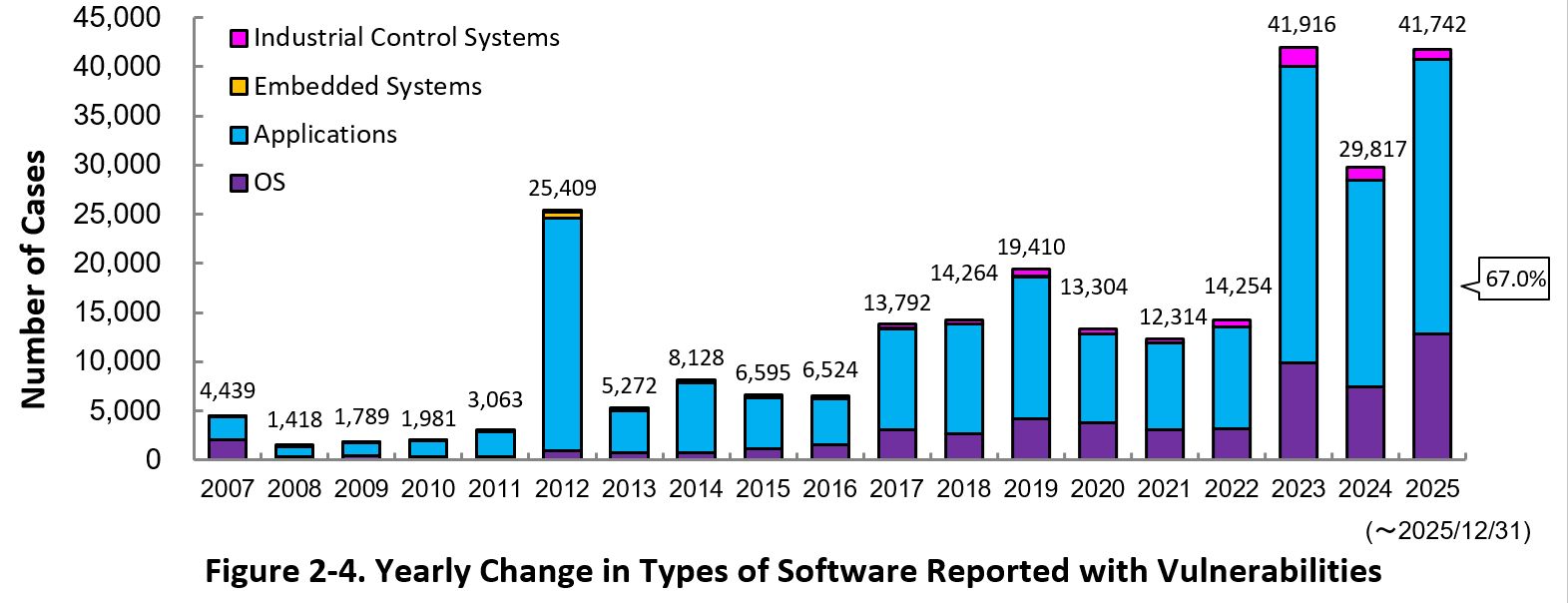
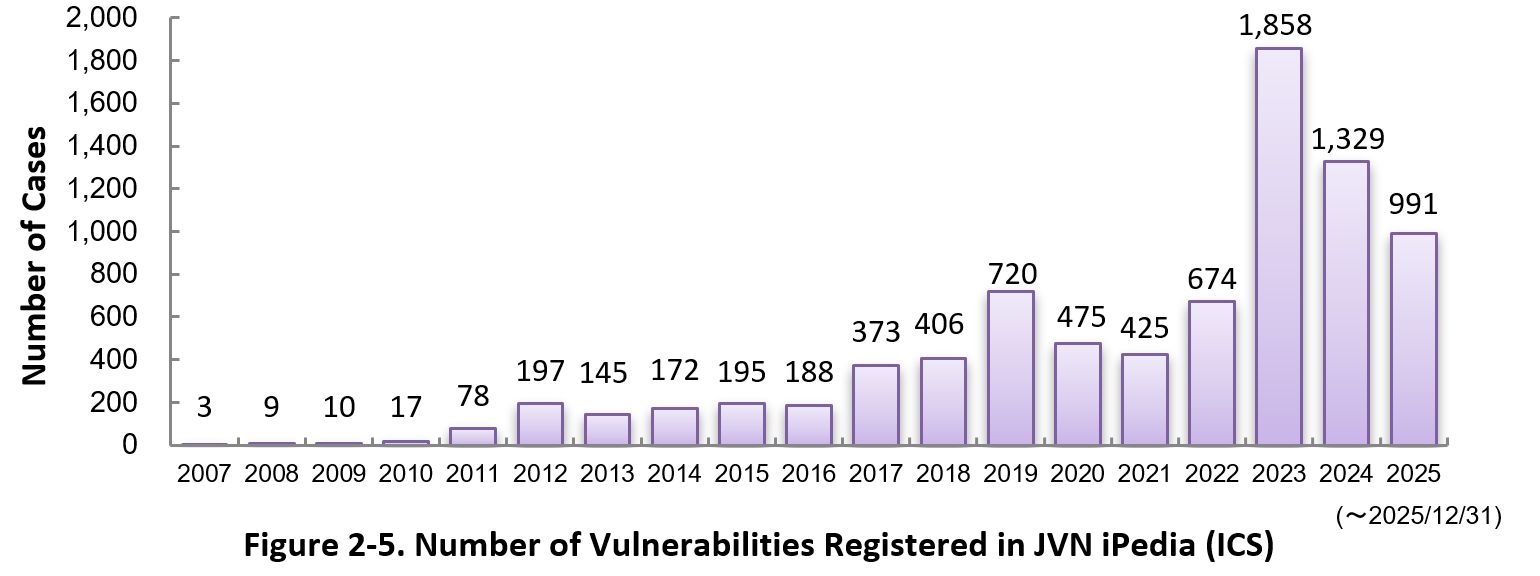
Figure 2-5 shows the yearly change in the number of JVN iPedia-stored vulnerabilities in industrial control systems (ICS) used in critical infrastructure sectors. As of December 2025, the total of 8,265 ICS vulnerabilities have been registered.
2-4. Products Reported with Vulnerability
Table 2-1 lists the top 20 software whose vulnerabilities were most registered to JVN iPedia during the fourth quarter (October 1 to December 31)of 2025.
This quarter, the most registered product was Linux Kernel, followed by Qualcomm components, Linux, and Microsoft operating systems.
Besides those in the top 20 list, JVN iPedia stores and offers vulnerability information about a variety of software. IPA hopes software developers and users will make good use of JVN iPedia to efficiently check vulnerability information and take necessary action in a timely manner (footnote 9).
Table 2-1. Top 20 most registered software products vulnerability countermeasure information in JVN iPedia [Oct. – Dec. 2025]
|
Rank
|
Category
|
Product Name (Vendor)
|
Number of
Vulnerabilities Registered |
|---|---|---|---|
|
1
|
OS
|
Linux Kernel (Linux) |
3,254
|
|
2
|
Firmware
|
Qualcomm component (Qualcomm) |
1,752
|
|
3
|
OS
|
Debian GNU/Linux (Linux) |
483
|
|
4
|
OS
|
Microsoft Windows Server 2025 (Microsoft) |
245
|
|
5
|
OS
|
Microsoft Windows 11 (Microsoft) |
238
|
|
6
|
OS
|
Microsoft Windows Server 2022 (Microsoft) |
227
|
|
7
|
OS
|
Microsoft Windows 10 (Microsoft) |
198
|
|
8
|
OS
|
Microsoft Windows Server 2019 (Microsoft) |
197
|
| 9 | OS | Microsoft Windows Server 2016 (Microsoft) | 155 |
| 10 | OS | Android (Google) | 145 |
|
11
|
DXP
|
Digital Experience Platform (Liferay) |
142
|
| 12 | OS | macOS (Apple) | 135 |
|
13
|
CMS | Adobe Experience Manager (Adobe) |
118
|
|
14
|
OS
|
Microsoft Windows Server 2012 (Microsoft) |
111
|
|
15
|
OS
|
iOS (Apple) |
92
|
|
15
|
OS
|
iPadOS (Apple) |
92
|
|
17
|
Browser
|
Google Chrome (Google) |
91
|
|
18
|
OS
|
Microsoft Windows Server 2008 (Microsoft) |
88
|
| 19 | Integrated Monitoring Software | Nagios XI (Nagios) | 80 |
|
20
|
Business software
|
Mattermost Server (Mattermost) |
75
|
3. Most Accessed Vulnerability Countermeasure Information
Table 3-1 lists the top 20 most accessed vulnerability countermeasure information in JVN iPedia during the fourth quarter (October 1 to December 31)of 2025.
This quarter, all of the top 20 were vulnerability countermeasure information published in Japan Vulnerability Notes (JVN), the vulnerability countermeasure information portal.
Table 3-1. Top 20 Most Accessed Vulnerability Countermeasure Information in JVN iPedia [Oct. – Dec. 2025]
|
Rank
|
ID/Title
|
CVSSv2
Base Score
|
CVSSv3
Base Score
|
Publication Date
|
Access Count |
|---|---|---|---|---|---|
|
1
|
-
|
4.8
|
December 16, 2024
|
7,160
|
|
|
2
|
-
|
4.8
|
November 26, 2024
|
6,277
|
|
|
3
|
-
|
-
|
December 25, 2024
|
5,604
|
|
|
4
|
-
|
4.8
|
November 13, 2024
|
5,534
|
|
|
5
|
JVNDB-2020-005056
jQuery vulnerable to cross-site scripting (in Japanese only) |
4.3
|
6.1
|
June 5, 2020
|
5,005
|
|
6
|
JVNDB-2025-000001
PLANEX COMMUNICATIONS MZK-DP300N vulnerable to cross-site scripting |
-
|
4.8
|
January 8, 2025
|
4,967
|
|
7
|
-
|
-
|
December 23, 2024
|
4,696
|
|
|
8
|
JVNDB-2024-000128 |
-
|
9.8
|
December 16, 2024
|
4,520
|
|
9
|
-
|
9.4
|
December 17, 2024
|
4,455
|
|
|
10
|
-
|
4.3
|
February 4, 2025
|
4,428
|
|
|
11
|
JVNDB-2025-000004 |
-
|
7.5
|
January 22, 2025
|
4,402
|
|
12
|
-
|
3.3
|
December 16, 2024
|
4,360
|
|
|
13
|
JVNDB-2023-000085 |
4.3
|
3.6
|
August 24, 2023
|
4,167
|
|
14
|
JVNDB-2025-000006
WordPress Plugin "Simple Image Sizes" vulnerable to cross-site scripting |
-
|
4.8
|
January 28, 2025
|
4,125
|
|
15
|
JVNDB-2025-001027
Linux Ratfor vulnerable to stack-based buffer overflow |
-
|
7.0
|
January 16, 2025
|
3,875
|
|
16
|
JVNDB-2024-014793
Multiple vulnerabilities in FXC AE1021 and AE1021PE |
-
|
7.5
|
December 16, 2024
|
3,785
|
|
17
|
JVNDB-2024-000078
Multiple vulnerabilities in ELECOM wireless LAN routers |
-
|
6.8
|
July 30, 2024
|
3,689
|
|
18
|
JVNDB-2024-000124
Multiple vulnerabilities in UNIVERGE IX/IX-R/IX-V series routers |
-
|
7.2
|
December 2, 2024
|
3,618
|
|
19
|
-
|
-
|
December 6, 2024
|
3,595
|
|
|
20
|
JVNDB-2025-000003
FortiWeb vulnerable to SQL injection |
-
|
2.7
|
January 21, 2025
|
3,544
|
Table 3-2 lists the top 5 most accessed vulnerability information among those reported by domestic software developers.
Table 3-2. Top 5 Most Accessed Vulnerabilities Reported by Domestic Product Developers [Oct. – Dec. 2025]
|
Rank
|
ID/Title
|
CVSSv2
Base Score
|
CVSSv3
Base Score
|
Publication Date
|
Access Count |
|---|---|---|---|---|---|
|
1
|
-
|
9.4
|
December 17, 2024
|
4,455
|
|
|
2
|
JVNDB-2025-001244
Clickjacking Vulnerability in JP1/ServerConductor/Deployment Manager |
-
|
-
|
January 30, 2025
|
2,541
|
|
3
|
-
|
-
|
September 11, 2024
|
2,490
|
|
|
4
|
JVNDB-2024-009498
Vulnerability in Cosminexus |
-
|
-
|
October 1, 2024
|
1,160
|
|
5
|
JVNDB-2024-002961
Information Exposure Vulnerability in Cosminexus Component Container |
-
|
5.6
|
March 13, 2024
|
435
|
Footnotes
(1) Japan Vulnerability Notes: A portal for vulnerability countermeasure information including information on vendor response to the reported vulnerabilities and security support. Operated in the collaboration of IPA and JPCERT/CC.
(2) National Vulnerability Database: A vulnerability database operated by NIST.
(3) National Institute of Standards and Technology: A U.S federal agency that develops and promotes measurement, standards and technology.
(4) Vulnerability Countermeasure Guide for Software Developers (in Japanese only)
(5) How to Secure Your Websites (latest version in Japanese only)
(6) AppGoat (in Japanese only)
(7) NIST - "Retirement of CVSS v2"
(8) IPA Data Feeds (in Japanese only)
(9) IPA Technical Watch - Daily Practice Guide (in Japanese only): Tips on Vulnerability Management The guide gives tips on how to efficiently collect and leverage vulnerability information.
Past Quarterly Reports
Contact information
IT Security Center,
Information-technology Promotion Agency, Japan (ISEC/IPA)