

Roundtable Discussion Part 1: Research Team Members Analyze the Reality of OSS in Various Countries and Differences in Development Models
International Comparative Study Report on Open Source Software Publication Activities by Governments
“Is Japan falling behind the rest of the world in promoting OSS?”—In response to this vague concern, this project collected and analyzed quantitative data from GitHub. Having collected and analyzed 30,298 repositories across seven countries, what characteristics and trends did the research team uncover behind the numbers? Based on these objective data points, the team discussed Japan’s position relative to other nations and the differences in OSS promotion models across countries from various perspectives.
The comments expressed are the personal views of the speakers and do not represent the official stance of their respective organizations.
Participants
Kazuki Imamura

- IPA Digital Infrastructure Center, Software Engineering Group
-
13 years of experience as a web engineer. She began civic tech activities in 2018. Assumed current position in March 2024.
Serves as project leader for this survey.
Hiroyuki Fukuchi

- IPA Digital Infrastructure Center, Software Engineering Group
-
Engaged in international standardization activities and embedded software development. He has been involved in open-source promotional activities since 2016. Seconded to the IPA in 2025. As part of community activities, participated in the launch of the Japan Working Group (Japan WG) of the OpenChain Project.
For this study, he is responsible for proposing research methods, conducting the survey, analyzing data, and writing the report.
Shin Okamoto

- Technical Adviser of IPA / Representative Director, monlon General Incorporated Association
-
Graduated from the Graduate School of Kyoto Institute of Technology, where he conducted research and practice in service design and participatory design for identifying and solving public issues. In this study, he was responsible for writing Chapters 1, 2, and 5.
Shinya Kohashi

- Technical Adviser of IPA / Service Designer, Design Leadership, Concent Co., Ltd.
-
As a service designer, he leads projects in new business development, UX design, and organizational design management support. Since 2014, he has also been conducting research activities through “PUBLIC DESIGN LAB.” to explore the potential of service design in the public sector.
For this study, he provided support for article editing and writing and served as the moderator for this roundtable discussion.
The Preconception That “Japan Is Lagging Behind” Debunked by Data
- Kohashi:
-
This research project was an attempt to verify the long-held, intuitive pessimism that “Japan lags behind the West in digitalization and OSS adoption” by introducing “facts” in the form of quantitative data from GitHub for the first time. Please share your candid impressions after actually collecting and analyzing this vast amount of data.
- Fukuchi:
-
What impressed me most while leading this research was how the analysis of activity levels visualized each country’s positioning—in other words, their “current status.” Until now, Japan has often been described as “doing nothing” or “lagging behind,” but when we actually plotted the data, the picture was completely different. Of course, there is a gap compared to countries with overwhelming scale like the UK and the US, but we found that Japan actually sits in the same group as countries considered digital leaders—such as Germany, Singapore, and Estonia—and that there is a certain level of activity.
-
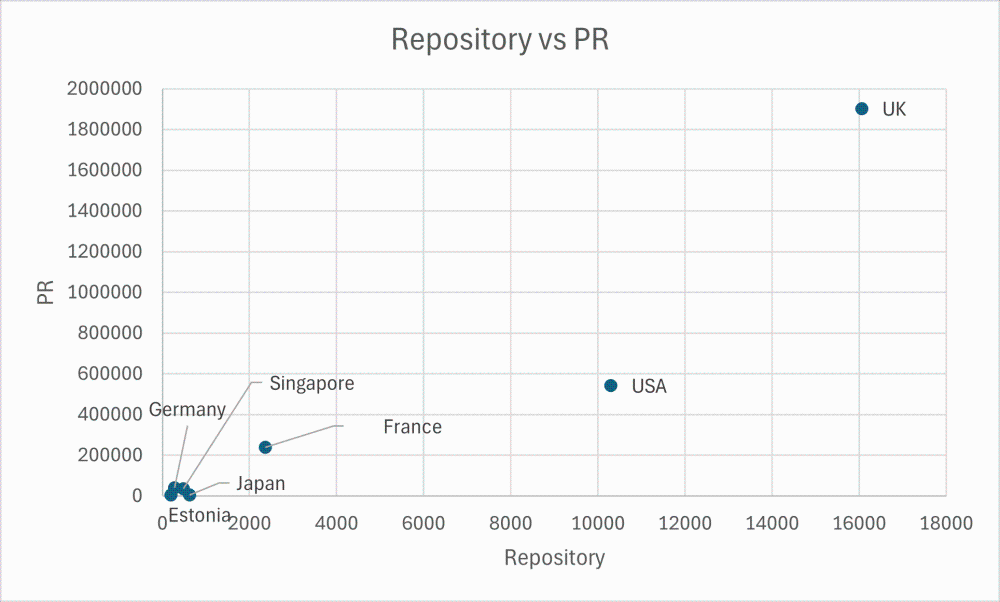
Repository Count and Pull Request Count (7-Country Comparison) -
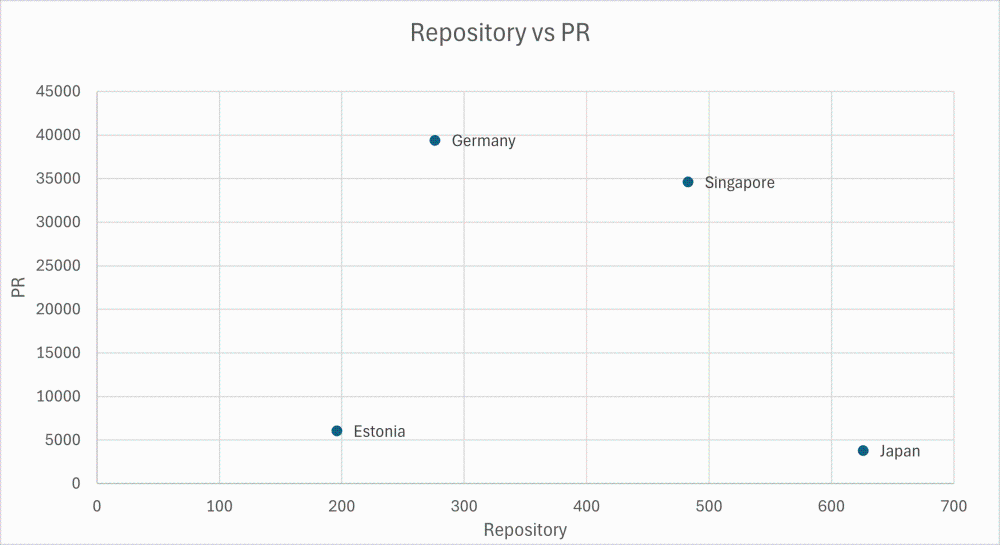
Repository Count and Pull Request Count (4-Country Comparison)
- Imamura:
-
Perhaps we’ve been a bit too caught up in “intuitive pessimism” without any real evidence.
- Fukuchi:
-
That’s right. Rather than simply lamenting that we’re “behind,” we’ve recognized that there are projects already in motion and that we’re experimenting and refining our approach in a similar position to other countries. The greatest takeaway from this study is that we’ve been able to accurately assess our current standing.
- Kohashi:
-
The data collection process itself was also very difficult. On GitHub, there isn’t a single “government” account; instead, accounts are scattered across various ministries and projects. Just because we identified a country didn’t mean we could immediately retrieve the data; the process of identifying each organization one by one was a very painstaking and arduous task.
- Fukuchi:
-
That’s right. We worked hard to compile this list, and I don’t see many other examples of such a comprehensive catalog. Therefore, I believe that not only the analysis results but also this “catalog of data itself” will be a valuable asset for future research.
- Imamura:
-
By examining the data in detail, we’ve been able to see the specific circumstances and differences in development phases faced by each country. I believe this has become the first step toward exploring “Japan’s own winning strategy,” rather than vaguely aiming for a large-scale model like the EU.
Differences in “Development Models” as Revealed by Country Data
- Kohashi:
-
Are the differences in the scale of activities merely a matter of “quantity,” or are there qualitative differences as well? What differences could you discern from the shape and distribution of the graphs?
- Fukuchi:
-
For example, looking at the UK’s data, activities began around 2010, and the number of repositories surged with the establishment of the GDS (Government Digital Service) in 2012. It appears that a specific, powerful core organization first created a successful model and then scaled it horizontally, leading to this growth. In contrast, in the U.S., rather than having a specific core organization driving OSS promotion, the number of initiatives is growing as many agencies as possible within the federal government operate autonomously and in a decentralized manner, while also involving external stakeholders. It is characterized by a broad base, ranging from single, massive organizations like NASA to small research institutes.
- Kohashi:
-
Using an agricultural metaphor, one might say the UK is a centrally managed “plantation model,” while the US is a “rhizome model” where individual activities spread like underground stems. So, what about Japan?
- Imamura:
-
Japan hasn’t had a clear national OSS strategy. Looking at the data, activities in the “maps and GIS” sector led by the Ministry of Land, Infrastructure, Transport and Tourism (MLIT) and the Geospatial Information Authority of Japan (GSI) stand out as particularly mature. However, this is likely the result of having talented people in those areas who naturally focus on them in response to on-site needs.
- Fukuchi:
-
So, it’s a situation where specific fields have grown organically from on-site needs, rather than being strategically planted.
- Imamura:
-
You could say it has the strength of a “native species” that has taken root in the local soil, rather than an “invasive species.”
- Kohashi:
-
By the way, what are the characteristics of the other countries grouped with Japan?
- Fukuchi:
-
For example, Estonia’s activities are concentrated on a data integration platform called “X-Road.” Rather than allowing individual apps to proliferate, they adopt a style of intensively developing infrastructure that serves as a conduit for data. Similarly, in Singapore, we observed a tendency to focus on providing a development platform to improve efficiency, rather than on open-source software (OSS) for administrative services per se.
- Kohashi:
-
I see. Just as Japan is focused on the mapping and GIS fields, the countries in the mid-sized group share the common trait of concentrating their resources on specific platforms or infrastructure.
- Okamoto:
-
A unique ecosystem has already taken shape within Japan’s public OSS community in the GIS field. It’s not because someone told them to; rather, government practitioners are sharing and using these tools because they are necessary for their own work and services. Shining a light on these “native species” and formulating strategies to increase use cases like theirs might be Japan’s unique path to success.
- Fukuchi:
-
There are also interesting differences when looking at a radar chart comparing key metrics(Note1). While the UK has a large number of contributors (development participants), the US tends to have higher metrics indicating external engagement—such as the number of stars, which reflects interest in a repository, and the number of forks, which indicates repository replication. Although Japan’s scale, based on the data, does not match that of these countries, it is positioned in the same group as Singapore and Estonia, and the distribution pattern of its key metrics is classified as typical of a medium-sized country.
-
Note1The survey report evaluated the project based on seven key metrics: "number of repositories," "number of stars," "number of forks," "number of branches," "number of issues," "number of pull requests," and "number of contributors."
-
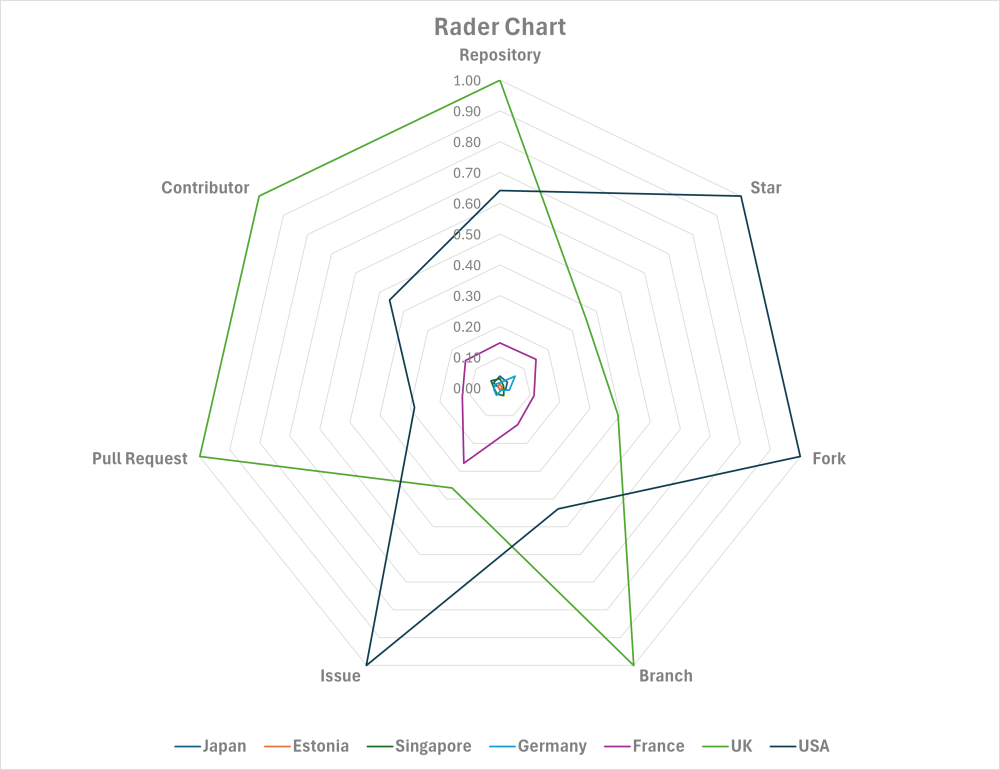
Radar Chart of Key Metrics (7-Country Comparison) -
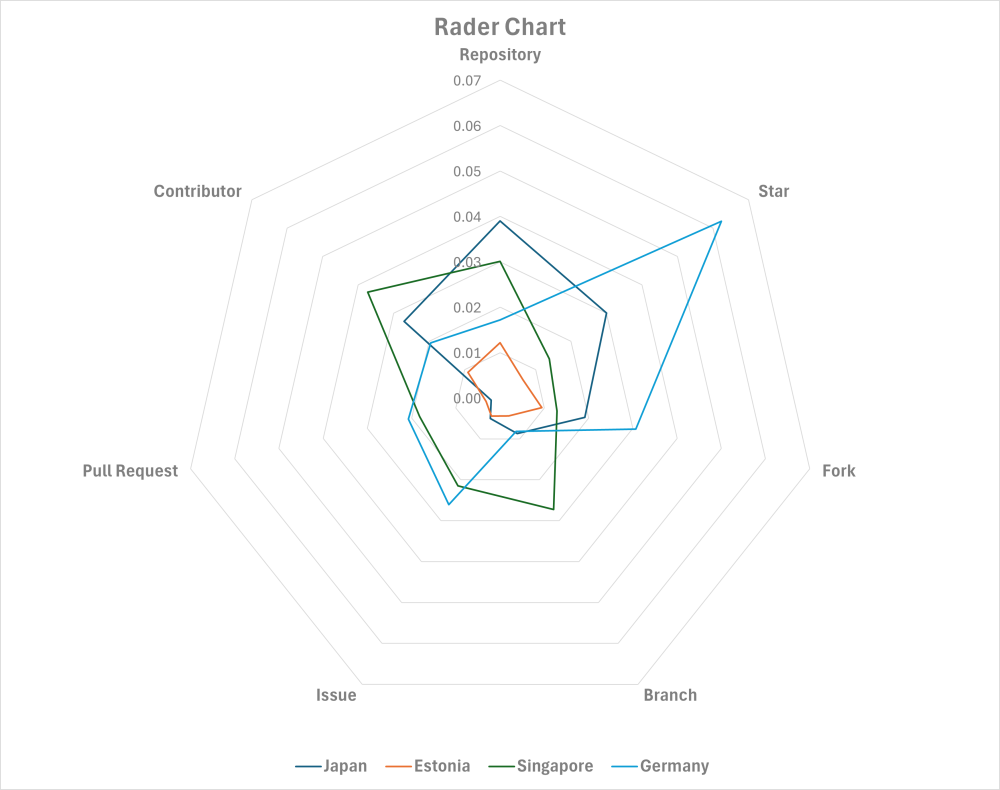
Radar Chart of Key Metrics (4-Country Comparison)
- Kohashi:
-
I see. Just like growing plants, the process of forming an ecosystem isn’t uniform. Even if we say, “We should aim for the British model,” and suddenly try to create a plantation, it might not suit Japan’s soil. Rather, we need to consider a “farming method” unique to Japan—how to protect the “native species” that are already growing wild and how to plant new species around them.
Publishing "Recipes" to Enhance Reusability
- Fukuchi:
-
Another finding from this survey concerns the content of the OSS released by government agencies. When we estimated the technical fields, about one-third of the total consisted not of the application itself (the finished product), but of “development tools (test code, documentation, CI/CD, SDKs, etc.).”
-
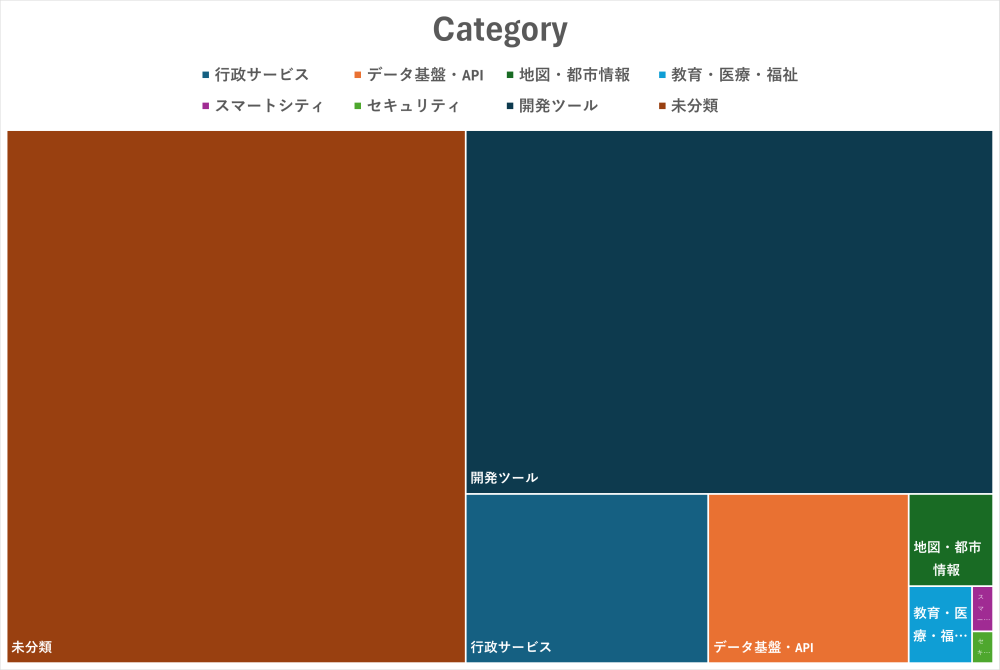
Classification by Technology Field Across OSS Repositories in 7 Countries (Treemap)
- Kohashi:
-
That’s very interesting. Using the cooking metaphor, is it like releasing not just the finished “dish,” but the “recipe and cooking utensils” as a set?
- Fukuchi:
-
Exactly. For example, by publishing test methods and SDKs (development kits), we can see the intention to lower barriers to entry for others and make reuse easier. Providing tools that say, “You can create the same thing using this,” or “You can test whether it works correctly this way,” contributes more to the ecosystem than simply releasing the software itself. There are similar examples in Japan as well. For instance, I heard that the Ministry of Land, Infrastructure, Transport and Tourism’s 3D city model project, “PLATEAU,” saw a sudden surge in downloads after it became compatible with Unity (the game engine).
- Imamura:
-
That’s right. According to people involved, providing converters not only for Unity but also for general-purpose tools like Minecraft broadened the user base. It highlights the importance of an approach that adapts to tools with existing users rather than imposing proprietary specifications.
- Kohashi:
-
Is that like a professional Chinese chef providing a recipe for authentic Mapo Tofu that anyone can make with just a single frying pan at home? Rather than forcing the government’s proprietary systems on users, the key to exponentially increasing the user base lies in adapting to the general-purpose environments of the private sector.
- Okamoto:
-
That’s a crucial point. With OSS, it doesn’t end with simply “releasing it”; post-release activities—such as “who will use it and how”—are vital. The fact that so many development tools are publicly available may be a sign that there is a strong emphasis on reuse.
- Fukuchi:
-
As a researcher, I also felt that organizing metadata (attribute information) is a challenge. Currently, there are many items that cannot be classified. If information such as “This is a testing tool for creating map apps” were provided, it would make it easier for engineers to access the resources and improve the accuracy of analysis.
- Kohashi:
-
It would be helpful to view OSS not only by domain (such as maps or healthcare) but also from the perspective of whether it is a “finished product or a tool.”
- Okamoto:
-
Regarding infrastructure-related aspects such as metadata management, this seems likely to be one of the key roles of the OSPO (Open Source Program Office), which is expected to be established within the government in the future. For the OSPO to better manage OSS, it is crucial to continuously conduct surveys on international trends like this one and compare them with domestic trends to understand the current situation. Building on that, improving metadata to facilitate comparisons between domestic and international repositories and constructing an OSS catalog based on that metadata are key goals to achieve.
"Momentum" as Seen in the Numbers and Challenges in Organization
- Fukuchi:
-
Another noteworthy aspect of OSS in Japanese government is the high number of stars, which indicates the level of attention. For example, while the Digital Agency had only seven repositories at the time of the survey—a relatively small number—the number of stars, at 1,043, is exceptionally high. This may reflect the latent enthusiasm of external engineers who want to “be involved in national projects,” “help out,” or “keep an eye on them.”
-
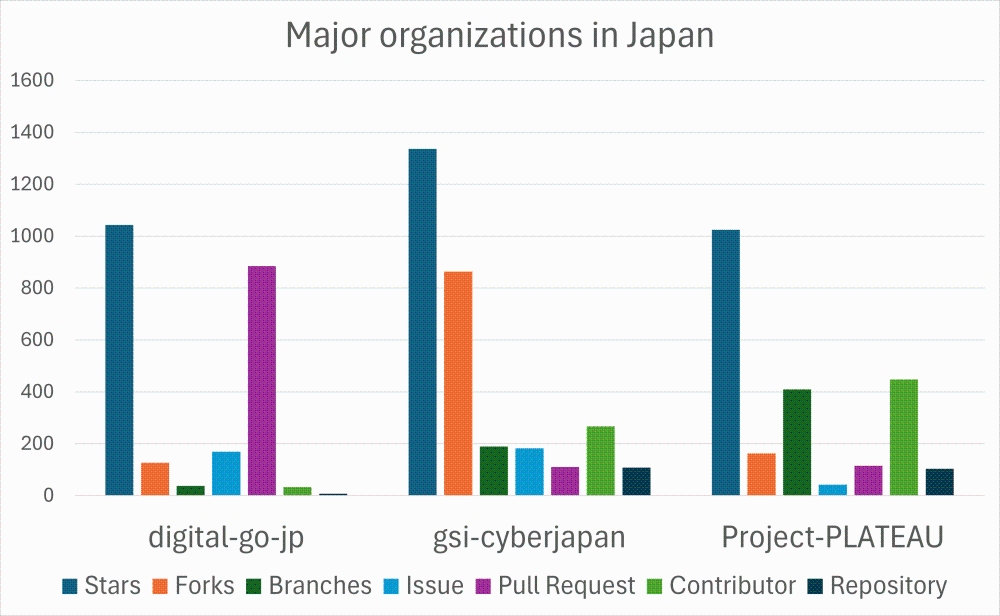
Comparison of Key Metrics Across GitHub Accounts for the Digital Agency (digital-go-jp), the Geospatial Information Authority of Japan (gsi-cyberjapan), and the Ministry of Land, Infrastructure, Transport and Tourism (Project-PLATEAU)
- Kohashi:
-
So, even though the numbers are small, expectations are high.
- Okamoto:
-
That’s true. On the other hand, while there is growing interest in distinctive OSS projects at the individual level in Japan, I think it’s fair to say that this have not translated into organizational action or cross-sectoral adoption. For example, could the issue of “reliance on specific individuals” be behind the fact that OSS projects which have seen localized momentum within specific fields—such as mapping and GIS—have not been adopted across other sectors or government agencies?
- Imamura:
-
That’s right. Looking at current success stories in Japan, it’s true that “person-dependent reasons”—such as the fact that talented individuals just happened to be there—play a significant role. While these initiatives are currently managing to function by relying on the skills and personal dedication of specific staff members, I believe the challenge for the next phase is how to transform this into an organizational asset and create a sustainable system that can endure even personnel change. Furthermore, we need to consider strategies not only for building something uniquely Japanese from scratch but also for how to ride the global trends and integrate into larger ecosystems.
- Kohashi:
-
So, you’re saying we need both perspectives: “nurturing native species” and “successfully crossbreeding with strong foreign species.” This roundtable has shown that Japan is by no means barren ground; rather, it is rich soil where the passion of those on the front lines and native species coexist. Thank you all very much.