

3.Survey Data
International Comparative Study Report on Open Source Software Publication Activities by Governments
The countries surveyed were selected based on the following two criteria:
- Visibility of activity on GitHub:
- The existence of official government accounts on GitHub where ongoing activity can be continuously observed
- Digital government advancement:
- Ranking highly in the UN E-Government Survey and various digital government assessments
Based on these criteria, the following seven countries were selected.
- Asia
-
- Japan (primary focus of the study)
- Singapore (City-state and smart city pioneer)
- Europe
-
- Estonia (e-government pioneer)
- Germany (Federal system, emphasis on digital sovereignty)
- France (centralized government, startup-style approach)
- United Kingdom (GDS founding nation, digital service standards developer)
- North America
-
- United States (Federal system, large-scale ecosystem)
While other GitHub-using countries like China and India exist, this study focuses on the above seven nations to maintain analytical consistency.
This section introduces representative government agencies' OSS activities and survey data from each country.
To understand each country's OSS promotion status, it is crucial to grasp the initiatives undertaken by the government agencies responsible for these activities. We highlight representative government agencies in each country, showing trends in OSS disclosure and related projects. This allows us to concretely confirm how each country utilizes open source and positions it as a digital public good.
3.1 Japan
- GitHub Statistics:
-
- Number of Organizations: 22
- Number of repositories: 626
Multiple ministries and agencies within Japan have begun utilizing and publishing OSS. Expansion is underway across various fields, including API development and the publication of geospatial data.
3.1.1 Ministry of Land, Infrastructure, Transport and Tourism (Project PLATEAU)
- GitHub Statistics (Total):
-
- Repositories: 103
- Stars: 1,025
- Forks: 163
- Branches: 409
- Branches: 409
- Pull requests: 115
- Contributors: 448
Project PLATEAU promotes the utilization of 3D urban space models as open data across diverse fields such as urban planning, disaster prevention, and traffic simulation. The project is designed with collaboration between local governments, private companies, and research institutions as a prerequisite, and active pilot testing and joint development are underway. Its high-precision 3D urban models, which include building shapes and terrain information, serve as reference cases for building digital twins of cities both domestically and internationally. Improvements based on user feedback are continuously implemented, making it a notable, pioneering initiative in the open sharing of spatial information.
-

Figure 3-1 Project PLATEAU (Ministry of Land, Infrastructure, Transport and Tourism, n.d.)
3.1.2 Geospatial Information Authority of Japan (gsi-cyberjapan)
- GitHub Statistics (Total):
-
- Repositories: 108
- Stars: 1,336
- Forks: 864
- Branches: 189
- Issues: 182
- Pull requests: 111
- Contributors: 267
The Geospatial Information Authority of Japan (GSI) is the most active open-source contributor in Japan for the development and publication of geospatial information. It has released numerous map data sets and Geographic Information System (GIS) tools, which are increasingly being reused by local governments and research institutions. Visualization tools for elevation data and topographic maps are expected to be utilized in disaster prevention, urban planning, and education. Collaboration with external developers is also progressing, making it a model for promoting open data in the geospatial field. Technologically, it is recognized for its stable operation and continuous improvement efforts.
-

Figure 3-2 Geospatial Information Authority Map (Geospatial Information Authority of Japan, n.d.)
3.1.3 Digital Agency (digital-go-jp)
- GitHub Statistics (Total):
-
- Repositories: 7
- Stars: 1,043
- Forks: 127
- Branches: 37
- Issues: 170
- Pull requests: 884
- Contributors: 33
The agency conducts highly concentrated and high-profile open-source activities for a limited number of projects. Development primarily focuses on areas directly improving public services, such as streamlining administrative procedures and establishing API infrastructure. Initiatives like the Government API Catalog and Myna Portal integration tools serve as reference cases for government agencies in other countries from the perspectives of reusability, transparency, and standardization. External improvement proposals and technical collaboration are active, with concentrated efforts by a small number of developers yielding significant results.
-

Figure 3-3 Design System (Illustrations and Icon Assets) (Digital Agency (Government of Japan), n.d.)
3.2 Estonia
- GitHub Statistics:
-
- Number of Organizations: 6
- Number of repositories: 196
Specializing in core e-government technologies, it achieves high completion rates and citizen usage through a small, elite project team.
3.2.1 E-government building blocks (e-gov)
- GitHub Statistics (Total):
-
- Repositories: 91
- Stars: 140
- Forks: 181
- Branches: 287
- Issues: 337
- Pull requests: 905
- Contributors: 748
E-gov is the core organization supporting Estonia's e-government infrastructure, building systems that enable citizens to complete administrative procedures such as resident registration, tax payments, and medical records entirely online. Through a secure authentication system linked to national IDs, it achieves both convenience and security in public services. Nearly the entire population utilizes electronic IDs, creating a rare global model where every day administrative tasks are completed digitally. This system is widely referenced in other countries' e-government development efforts.
-

Figure 3-4 E-government building blocks (e-Estonia, n.d.)
3.2.2 Open Electronic Identity (open-eid)
- GitHub Statistics (Total):
-
- Repositories: 69
- Stars: 1,002
- Forks: 531
- ranches: 236
- Issues: 640
- Pull requests: 4,906
- Contributors: 531
Open-eid is a project providing the technological foundation for Estonia's electronic ID and digital signature systems. It maintains libraries and tools supporting secure identity verification, electronic signatures, and encrypted communications, widely integrated into public and private services. Being open source ensures transparency and reliability, with high compatibility with international technical standards. As an advanced initiative in the field of electronic authentication, it attracts attention from government agencies and engineers worldwide.
-
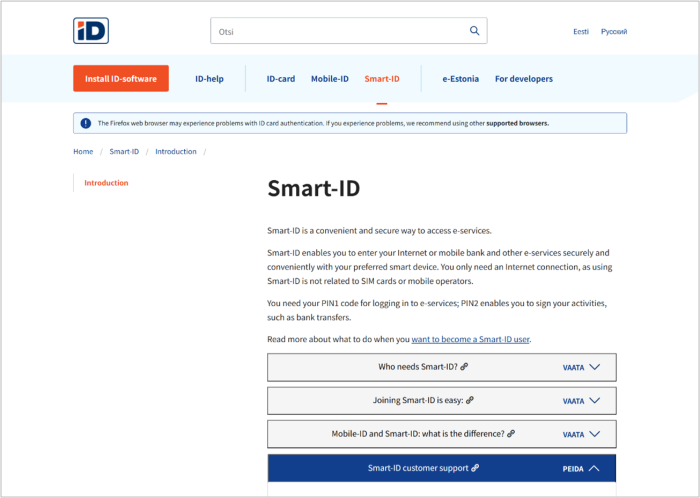
Figure 3-5 Smart-ID (e-Estonia, n.d.)
3.2.3 Information System Authority (ria-ee)
- GitHub Statistics (Total):
-
- Repositories: 11
- Stars: 184
- Forks: 94
- Branches: 50
- Issues: 10
- Pull requests: 236
- Contributors: 46
The Information System Authority is the core agency responsible for developing, operating, and maintaining the Estonian government's information systems, supporting the technological foundation of the digital government. It oversees national information security measures, cyber incident response, and technical support for ID cards and mobile ID, providing infrastructure that underpins public trust. It also manages the "X-Road" platform, ensuring the interoperability of administrative services and enabling secure data exchange between government agencies. In recent years, it has also focused on enhancing the convenience of citizen services, such as developing the mobile app for the eesti.ee portal.
-
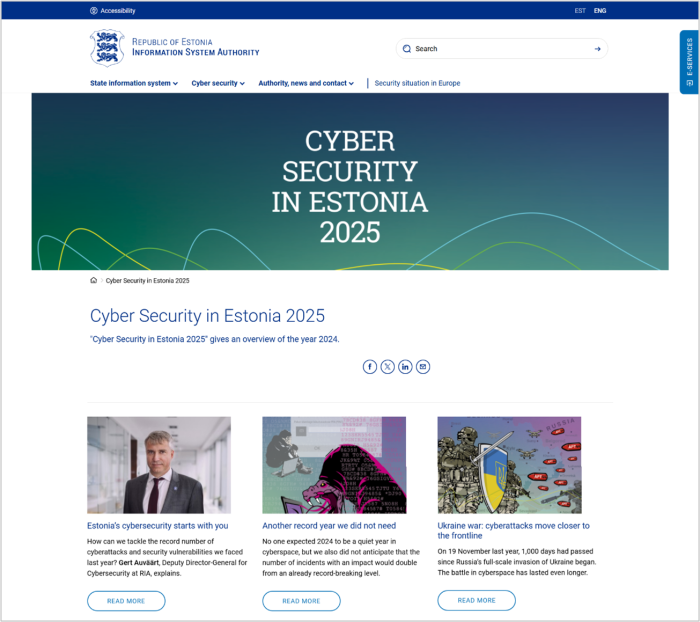
Figure 3-6 Cyber Security in Estonia 2025 (Information System Authority (RIA), n.d.)
3.3 Singapore
- GitHub Statistics:
-
- Number of Organizations: 5
- Number of repositories: 483
Emphasizes collaboration with citizens, promoting policy transparency and public service improvements through OSS.
3.3.1 Open Government Products (opengovsg)
- GitHub Statistics (Total):
-
- Repositories: 128
- Stars: 1,461
- Forks: 451
- Branches: 1,848
- Issues: 2,664
- Pull requests: 26,567
- Contributors: 1,177
Open Government Products is the organization spearheading the Singapore government's open-source strategy, developing numerous tools to enhance transparency in public services and encourage citizen participation. Systems are in place enabling citizens to view and utilize election information, public budgets, policy proposals, and more, thereby supporting democratic decision-making. Development is publicly available on GitHub, fostering active external suggestions for improvements and technical feedback. Its design philosophy emphasizes collaboration with citizens.
-

Figure 3-7 Open Government Products (Government of Singapore, n.d.)
3.3.2 Government Technology Agency of Singapore (GovTech)
- GitHub Statistics (Total):
-
- Repositories: 175
- Stars: 577
- Forks: 394
- Branches: 2,092
- Issues: 377
- Pull requests: 4,816
- Contributors: 1,298
GovTechSG, as the technology arm of the Singapore government, plays a central role in the Smart Nation initiative. It drives the advancement and efficiency of public services through the adoption of AI, IoT, and cloud technologies. Key projects include TraceTogether (contact tracing app) and SingPass (digital ID), supporting services closely integrated into citizens' daily lives. Its development framework balances technical reliability with policy alignment, earning high international recognition.
-
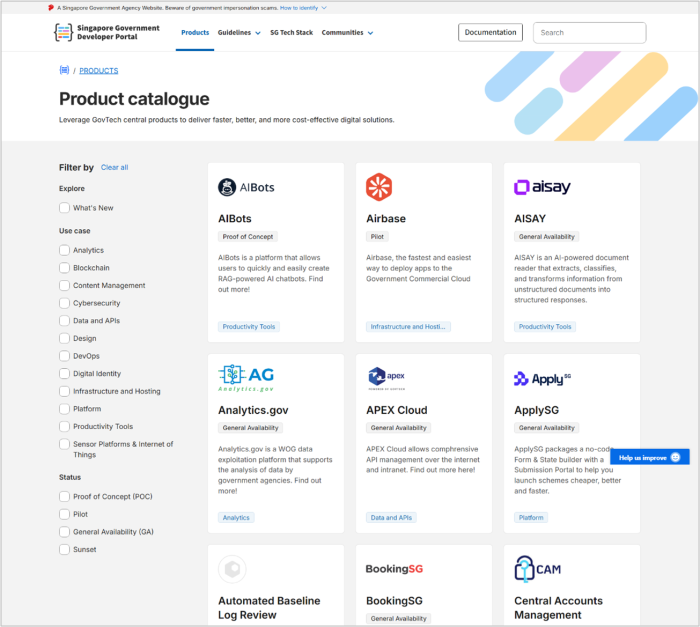
Figure 3-8 Product Catalogue (Government of Singapore, n.d.)
3.4 Germany
- GitHub Statistics:
-
- Number of Organizations: 8
- Number of repositories: 276
Multiple agencies collaborate in public health and administrative services, implementing distributed development utilizing OSS.
3.4.1 corona-warn-app
- GitHub Statistics (Total):
-
- Repositories: 39
- Stars: 10,674
- Forks: 2,143
- Branches: 246
- Issues: 4,824
- Pull requests: 15,645
- Contributors: 743
The Corona-Warn-App is a contact tracing app developed as a measure against the novel coronavirus. Its design, which balances privacy protection and transparency, has received high international acclaim. The implementation of Bluetooth-based contact detection technology and decentralized data management has influenced the development of public health apps in other countries. Commissioned by the German Federal Government, it was jointly developed by government agencies such as the Robert Koch Institute (RKI) and the Federal Office for Information Security (BSI), along with private companies including SAP and Deutsche Telekom.
-
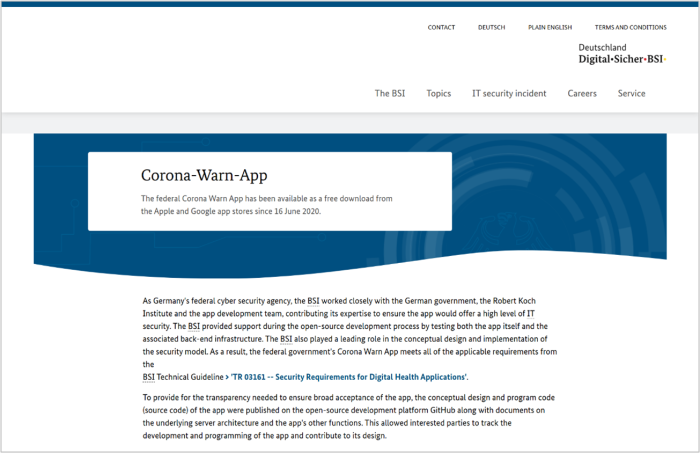
Figure 3-9 Corona-Warn-App (Federal Office for Information Security (BSI), n.d.)
3.4.2 DigitalService GmbH des Bundes (digitalservicebund)
- GitHub Statistics (Total):
-
- Repositories: 95
- Stars: 256
- Forks: 57
- Branches: 396
- Issues: 217
- Pull requests: 17,507
- Contributors: 877
DigitalService GmbH des Bundes is an organization promoting the digitization of administrative services for the German government. It aims to improve user experience while enhancing operational efficiency through various projects. Emphasis is placed on user-centered service design, such as improving online application forms and integrating the design of administrative portals. The organization prioritizes the integration of design and technology, with careful consideration given to accessibility and multilingual support. Active collaboration with private-sector UX experts significantly contributes to improving the quality of administrative services.
-

Figure 3-10 DigitalService (DigitalService GmbH of the Federal Government, n.d.)
3.4.3 Robert Koch Institute (Robert Koch-Institut / RKI)
- GitHub Statistics (Total):
-
- Repositories: 58
- Stars: 651
- Forks: 154
- Branches: 219
- Issues: 458
- Pull requests: 3,305
- Contributors: 323
The Robert Koch Institute is the core public health agency under the German Federal Ministry of Health, responsible for infectious disease control, epidemiological investigations, and health policy support. It was deeply involved in developing the Corona-Warn-App, providing technical oversight for the design of the contact detection algorithm and data management. Its research findings and technical tools are openly published and highly regarded in the international public health field.
-

Figure 3-11 Mission Statement(The Robert Koch Institute, n.d.)
3.5 France
- GitHub Statistics:
-
- Number of Organizations: 25
- Number of repositories: 2,359
Supports rapid service development by leveraging OSS with a startup-like approach to address administrative challenges.
3.5.1 National Digital Services Incubator (Incubateur de Services Numériques de l’État / betagouv)
- GitHub Statistics (Total):
-
- Repositories: 658
- Stars: 2,734
- Forks: 2,250
- Branches: 12,055
- Issues: 22,595
- Pull requests: 92,309
- Contributors: 10,589
Betagouv is an organization established as the French government's digital services incubator. Aiming to rapidly improve administrative services, it supports the experimental and flexible development of services by startup-style development teams. It deploys prototypes across diverse fields such as tax filing, employment support, and education, enhancing the agility of government and its responsiveness to citizen needs. Services are published on GitHub, emphasizing transparency and reusability as open source.
-
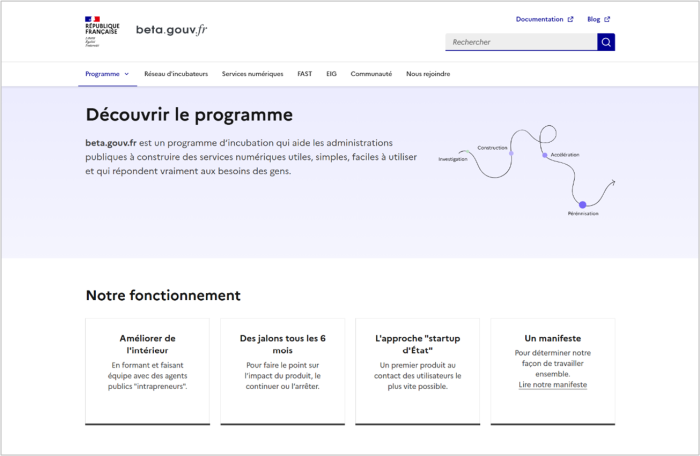
Figure 3-12 Discover the program (beta.gouv.fr, n.d.)
3.5.2 Social Ministries Digital Factory (La Fabrique numérique des Ministères Sociaux / SocialGouv)
- GitHub Statistics (Total):
-
- Repositories: 326
- Stars: 1,299
- Forks: 636
- Branches: 5,426
- Issues: 10,196
- Pull requests: 51,171
- Contributors: 2,639
SocialGouv is an organization promoting digitalization in the social security and welfare sectors. It provides information, application support, and data disclosure in areas closely tied to citizens' lives, such as employment, healthcare, and family support. It adheres to thorough user-centered design and prioritizes accessibility. Operating as part of BetaGouv.fr, it also supports rapid digital responses to administrative challenges.
-

Figure 3-13 The Digital Factory of the Social Ministries (La Fabrique numérique des Ministères Sociaux, n.d.)
3.5.3 etalab
- GitHub Statistics (Total):
-
- Repositories: 293
- Stars: 2,725
- Forks: 1,276
- Branches: 1,567
- Issues: 4,519
- Pull requests: 13,791
- Contributors: 1,743
Etalab is the core organization responsible for the French government's open data strategy. It designs and operates the government data portal data.gouv.fr, enhancing the transparency and reusability of public information through API development and data publication. It publishes diverse datasets including geographic information, statistics, and administrative procedures, promoting their utilization by researchers, businesses, and citizens.
-

Figure 3-14 Lab IA’s Knowledge Book (etalab-ia, n.d.)
3.6 United Kingdom
- GitHub Statistics Data:
-
- Number of organizations: 30
- Number of repositories: 16,058
Centered around GOV.UK, achieving integration and standardization of government services through OSS, with a focus on UX and reusability.
3.6.1 Government Digital Service (alphagov)
- GitHub Statistics (Total):
-
- Repositories: 1,659
- Stars: 13,727
- Forks: 7,961
- Branches: 17,572
- Issues: 16,528
- Pull requests: 300,912
- Contributors: 29,894
Alphagov is the organization that develops and operates the UK government's unified web services, centered around GOV.UK. It rigorously applies user-centered design to enhance the searchability, understandability, and simplicity of administrative information and procedures. Incorporating continuous user testing and improvement cycles, it contributes to enhancing the UX of public services. Its design guidelines and component libraries are publicly available, widely recognized as a reference case for government portal development in other countries.
-

Figure 3-15 GOV.UK Design System (GOV.UK, n.d.)
3.6.2 Ministry of Justice (Ministry of Justice / ministryofjustice)
- GitHub Statistics (Total):
-
- Repositories: 2,380
- Stars: 3,650
- Forks: 3,458
- Branches: 21,605
- Issues: 25,256
- Pull requests: 388,455
- Contributors: 19,464
The Ministry of Justice is an organization promoting digital services related to the justice system. It undertakes a wide range of projects, including the digitization of court proceedings, search and viewing services for legal information, and prison management systems. Its designs are crafted to complement the complexity of the legal system through technology, with numerous features supporting user understanding and access. It is recognized as a leading example of digitalization within the legal field.
-
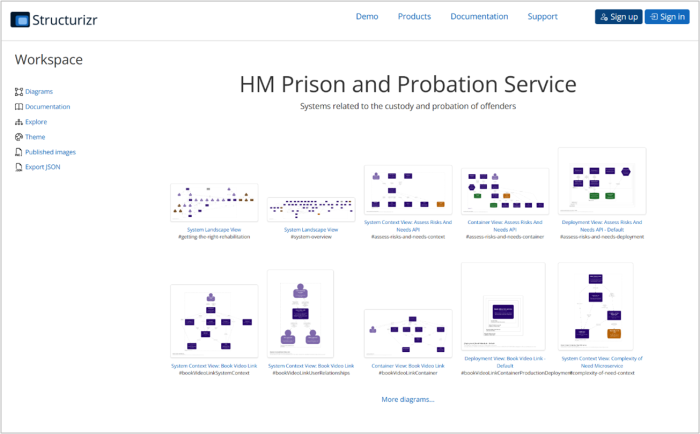
Figure 3-16 HM Prison and Probation Service (Structurizr, n.d.)
3.6.3 Her Majesty's Revenue and Customs (hmrc)
- GitHub Statistics (Total):
-
- Repositories: 1,633
- Stars: 1,974
- Forks: 3,317
- Branches: 10,047
- Issues: 1,685
- Pull requests: 197,758
- Contributors: 29,133
HMRC delivers digital services in the tax and finance sector. It balances operational efficiency with citizen convenience through online tax filing for taxpayers, API integration for businesses, and tax data visualization. Designed with a strong emphasis on security and reliability, it is recognized as a successful example of government OSS in the financial sector.
-

Figure 3-17 Engineering Guidance (HM Revenue & Customs, n.d.)
3.7 United States
- GitHub Statistics:
-
- Number of Organizations: 71
- Number of repositories: 10,300
In addition to OSS releases in science and technology fields by national laboratories, government agencies also promote common platforms and service improvements through OSS.
3.7.1 NASA
- GitHub Statistics (Total):
-
- Repositories: 596
- Stars: 53,732
- Forks: 14,128
- Branches: 5,925
- Issues: 18,113
- Pull requests: 35,138
- Contributors: 3,323
NASA publishes research results in the fields of space and Earth science as open source. Tools for weather simulation, orbital calculations, image analysis, and more are increasingly being reused by educational institutions and researchers, contributing to the democratization of science and technology. Documentation and datasets are also well-developed, serving as a foundation for international research collaboration.
-

Figure 3-18 Open Source Mission Control Software(NASA, n.d.)
3.7.2 General Services Administration (GSA)
- GitHub Statistics (Total):
-
- Repositories: 1,019
- Stars: 11,774
- Forks: 7,115
- Branches: 11,681
- Issues: 23,885
- Pull requests: 58,082
- Contributors: 8,401
GSA is the organization responsible for building the IT infrastructure across the entire U.S. government. It supports the digital transformation of government by providing common services and design guidelines. It develops and publishes generic tools such as form management, authentication infrastructure, and UI components, promoting cross-agency reuse. It plays a central role in establishing and promoting technical standards.
-
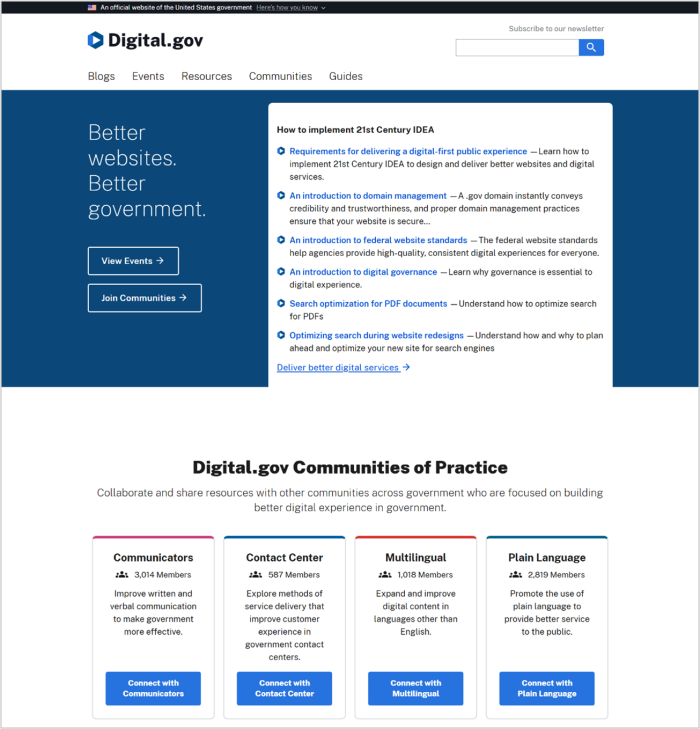
Figure 3-19 Digital.gov (U.S. General Services Administration, n.d.)
3.7.3 Lawrence Livermore National Laboratory (LLNL)
- GitHub Statistics (Total):
-
- Repositories: 608
- Stars: 13,008
- Forks: 3,893
- Branches: 4,466
- Issues: 9,740
- Pull requests: 22,032
- Contributors: 5,101
LLNL, as a U.S. national laboratory, conducts open-source software activities in the fields of high-performance computing, simulation, and data analysis. It releases open-source software across diverse domains, including numerical analysis, finite element methods, radiation simulation, compression algorithms, package management, visualization, compiler technology, and mathematical optimization using AI. These tools are also utilized in applied fields such as energy, security, materials science, meteorology, space, and healthcare.
-
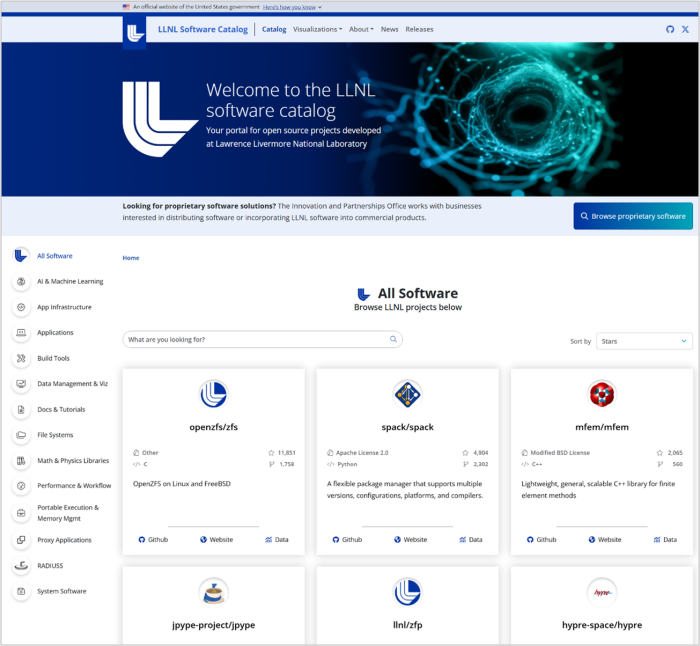
Figure 3-20 LLNL Software Catalog(Lawrence Livermore National Laboratory, n.d.)